Janam Kundli explained: what your Vedic birth chart really shows
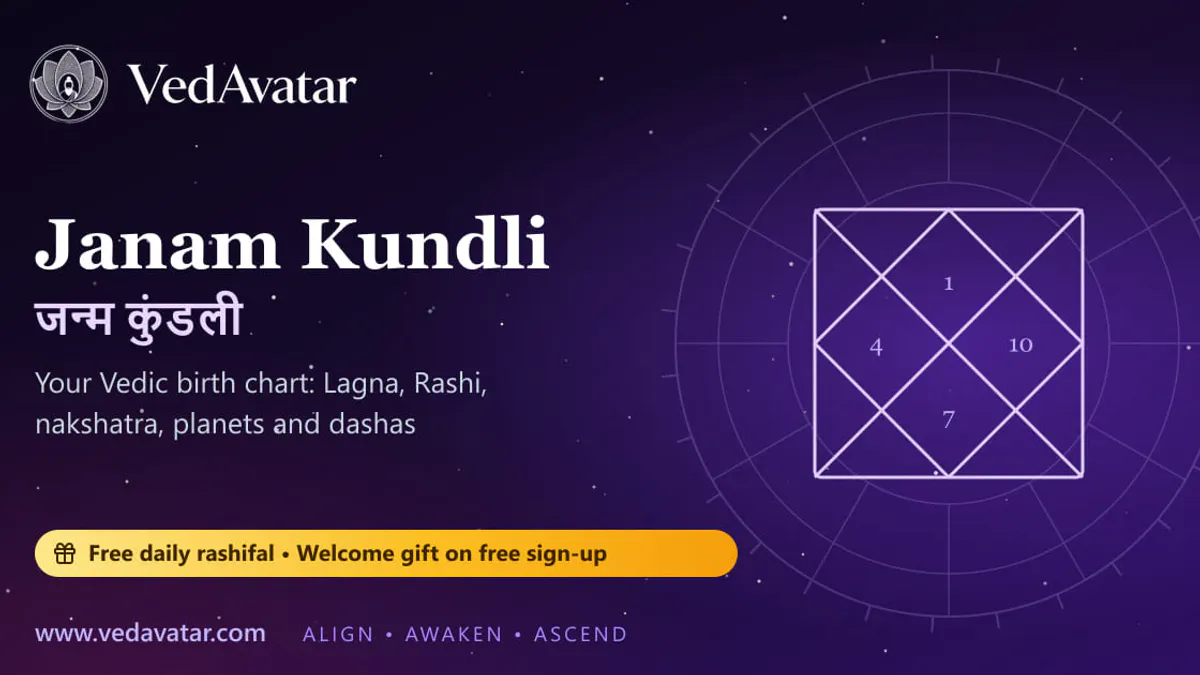
A janam kundli is a map of the sky at the exact moment and place you were born. It shows where the Sun, the Moon and the planets stood, which sign was rising on the eastern horizon, and how these sit across twelve houses that stand for the areas of life. Read well, it is less a verdict on your future than a mirror: it describes your nature, your strengths, the themes you keep meeting and the periods that suit different steps. This guide explains what a kundli contains, in plain words, and how VedAvatar calculates yours.
What a janam kundli is made of
Vedic astrology (Jyotish) measures the planets against the fixed stars, the sidereal zodiac, rather than against the seasons. The difference between the two zodiacs is the ayanamsa; VedAvatar uses the Lahiri (Chitrapaksha) ayanamsa, the standard one in India. Three things are needed to calculate a chart:
- your date of birth,
- your time of birth, as exact as you know it,
- your place of birth, because the rising sign and the houses depend on where on Earth you were.
From these, the chart places nine grahas (the Sun, Moon, Mars, Mercury, Jupiter, Venus, Saturn, Rahu and Ketu) in twelve signs and twelve houses.
The four facts to know first
If you remember only four things about your chart, make them these:
- Lagna (the ascendant): the sign rising in the east when you were born. It is the first house and colours your body, temperament and the way you meet the world. It changes about every two hours, which is why the birth time matters.
- Rashi (the Moon sign): the sign the Moon was in. In Vedic astrology this is the sign your daily horoscope is counted from, because the Moon stands for the mind and feelings.
- Nakshatra and pada: the Moon's lunar mansion, one of 27, each split into four padas. It is used for naming (the first syllable of a traditional name), for matching and for timing.
- The running dasha: the planetary period you are living through now, with its sub-period (Mahadasha and Antardasha). More on this below.
The twelve houses in plain words
Each house is one area of life. VedAvatar uses whole-sign houses, the traditional system in which each house is one whole sign counted from the Lagna.
| House | Areas of life |
|---|---|
| 1st | Self, body, temperament |
| 2nd | Family, savings, speech |
| 3rd | Courage, siblings, short journeys |
| 4th | Home, mother, comfort, property |
| 5th | Children, learning, creativity |
| 6th | Work routines, competition, wellbeing habits |
| 7th | Marriage and partnerships |
| 8th | Change, research, shared resources |
| 9th | Fortune, father, teachers, dharma |
| 10th | Career and public standing |
| 11th | Gains, friends, wishes fulfilled |
| 12th | Expenses, distant lands, rest and spirituality |
A planet in a house brings its nature to that area of life; the sign it sits in shows how comfortably it works there.
Planets, signs and strength
Not every planet works with the same strength. A planet can be exalted or in its own sign (comfortable), in an enemy's sign (strained), close to the Sun (combust) or moving backwards from Earth's view (retrograde). Two classical measures turn this into numbers:
- Shadbala, the six-fold strength of each planet;
- Ashtakavarga, which gives each sign a score from the support of the planets.
Yogas are special combinations, such as Gaja Kesari (Jupiter in an angle from the Moon). VedAvatar checks each yoga against its classical conditions rather than naming it loosely.
Timing: the Vimshottari dasha
The kundli also carries a clock. The Vimshottari dasha divides a 120-year cycle into periods ruled by the nine planets, starting from the Moon's nakshatra at birth. The planet whose period you are in brings its themes forward: a Saturn period often asks for patience and steady work, a Jupiter period tends to open learning and guidance. Within each Mahadasha run Antardashas, shorter sub-periods.
Transits add a second layer: where the planets are moving today, counted from your Moon sign and Lagna. The best known is Sade Sati, Saturn's roughly seven-and-a-half-year passage over the sign before your Moon sign, the Moon sign itself and the sign after it. It is a time for discipline and simplifying, not a curse.
Navamsa (D9) and Dasamsa (D10)
Divisional charts look at one area more closely. The Navamsa (D9) divides each sign into nine parts and is read for marriage and the inner strength of the planets. The Dasamsa (D10) divides each sign into ten and is read for career. VedAvatar's full Kundali report includes both.
What is calculated, and what is interpreted
It helps to know which parts of a reading are measurement and which are interpretation.
Calculated: the planets' positions come from Astronomy Engine, an open-source astronomy library tested against NASA JPL Horizons and accurate to about one arcminute. On top of these, VedAvatar's Vedic Core works out the Lagna, signs and houses, nakshatras and padas, the Vimshottari and Yogini dashas, Shadbala, Ashtakavarga, Sade Sati periods and the classical yogas. Its Panchang is checked against independent sources: in our latest test it agreed with 20 daily Panchangs for Indian and overseas cities and with the US Naval Observatory's sunrise and moon-phase tables in all 285 checks, sunrise within two minutes and the end times of tithi, nakshatra and yoga within four.
Interpreted: the written reading is produced by AI, which explains these computed facts with traditional rules, in Hindi or English. It is instructed never to work out a position or a date itself: it explains only the values the chart contains. Interpretation is guidance for reflection and decisions, not a certainty.
Not sure of your birth time?
Many people know only the day, or an approximate hour. The Lagna and houses can change within minutes, so VedAvatar does not guess. With the switch "I don't know my exact birth details", the chart keeps only what stays true for the whole possible birth window: usually the signs of the slower planets, and often the Moon sign. Where even the Moon sign is uncertain, the traditional Naam Rashi from the first syllable of your name is used. The reading then follows the Bhrigu Nandi Nadi method, which works from the planets' signs and their links, without the Lagna or houses.
Three myths about the kundli
- "A dosha is a curse." A dosha is a pattern that asks for care in one area. Many have classical cancellations, and none decides a life on its own.
- "The chart fixes my fate." The chart shows tendencies and timing. Choices, effort and circumstances shape what happens.
- "Remedies work like magic." Remedies such as mantras, charity or discipline in a planet's area are supportive practices. They are not substitutes for medical, legal or financial advice.
How to see your own chart
You can see your birth chart on VedAvatar without signing up: the Lagna, Moon sign, nakshatra and pada, the planets with their degrees and the running Mahadasha and Antardasha. The full Kundali report then explains the chart section by section, with the Navamsa and Dasamsa, the dashas, Sade Sati and the year ahead, with a PDF.
If you are planning a marriage, the next step is matching two charts; read our guide to Kundli Milan and the 36 gunas. To choose a good date for an important step, see how a shubh muhurat is chosen. And if you want one complete answer to your own questions, with dates, YUG Reading builds it from your whole chart.
Questions people ask
Is a janam kundli the same as a horoscope?
A horoscope usually means a forecast for a sign. A janam kundli is your personal birth chart, and your daily horoscope on VedAvatar is counted from your own Moon sign in it.
Which ayanamsa does VedAvatar use?
The Lahiri (Chitrapaksha) ayanamsa, the one used by most Indian Panchangs.
Can I see my kundli without signing up?
Yes. The birth chart, Lagna, Moon sign, nakshatra and running dasha are free on the Kundali page without an account.
Readings are traditional interpretation for guidance and self-reflection, not certainties, and not medical, legal or financial advice.