Mulank, Bhagyank and your name: numerology explained with examples
Numerology turns your date of birth and your name into a few small numbers, each read as a theme in your life. In Indian numerology the two that matter first are the mulank bhagyank pair: the Mulank (birth number) and the Bhagyank (destiny or life path number). Your name adds a third. This guide shows how each is worked out, with real examples, why two systems can give your name different numbers, and when changing the spelling of a name is worth thinking about.
Mulank: the number of your birth day
The Mulank comes only from the day of the month you were born, reduced to one digit.
- Born on the 14th: 1 + 4 = 5.
- Born on the 29th: 2 + 9 = 11, and 1 + 1 = 2.
The Mulank is read as your instinctive nature, the way you act when you do not stop to think. Each number has a traditional planet: 1 the Sun, 2 the Moon, 3 Jupiter, 4 Rahu, 5 Mercury, 6 Venus, 7 Ketu, 8 Saturn and 9 Mars.
Bhagyank: the number of your whole date
The Bhagyank adds every digit of the full date of birth.
- 14 August 1990: 1 + 4 + 0 + 8 + 1 + 9 + 9 + 0 = 32, and 3 + 2 = 5.
- 29 November 1987: the total reaches 11, and 11 is not reduced further.
Why not? 11, 22 and 33 are master numbers: tradition keeps them as they are, because they are read as a stronger, more demanding version of their single digit. The Bhagyank is read as the direction of your life, the lessons and work that keep returning.
Your name number: two systems
Your name becomes a number by giving each letter a value and adding them up. The two common systems give letters different values:
- Pythagorean: the letters A to Z take the values 1 to 9 in order, again and again (A = 1, B = 2 … I = 9, J = 1 …).
- Chaldean: an older table built on the sound of the letters; it gives the values 1 to 8 and never 9 to a letter.
The same name can therefore give two different numbers:
| Name | Pythagorean | Chaldean |
|---|---|---|
| Asha | 11 (a master number) | 1 |
| Rahul | 6 | 8 |
Neither is "wrong": they are two traditions. VedAvatar lets you choose either, and for a Hindi name it first writes the name in Roman letters, so that the letters can be counted.
Karmic debt numbers
Four totals, 13, 14, 16 and 19, are called karmic debt numbers when they appear in your birth day, on the way to your Bhagyank or inside your name. For 14 August 1990, the birth day itself is 14. They are read as a lesson that asks for more effort in one area, such as discipline for 13, balance and moderation for 14, humility for 16 and self-reliance with care for others for 19, not as a punishment.
The Lo Shu grid
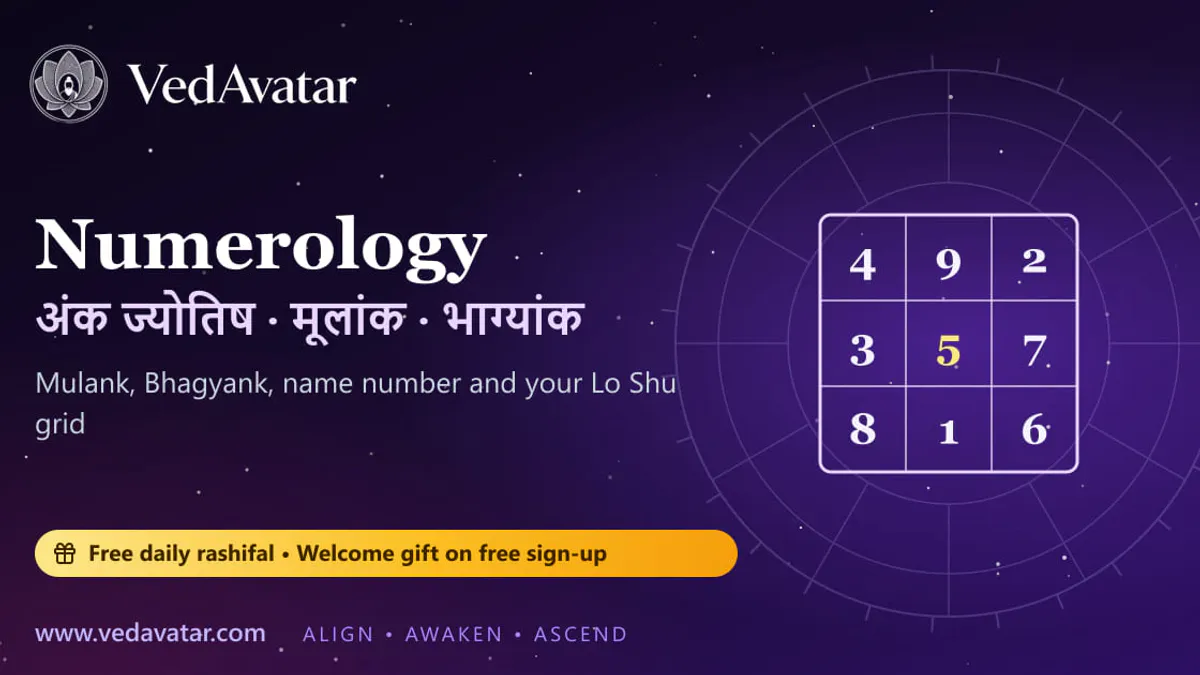
The Lo Shu is a 3 × 3 square that is very old in Chinese tradition: every row, column and diagonal adds up to 15.
| 4 | 9 | 2 |
|---|---|---|
| 3 | 5 | 7 |
| 8 | 1 | 6 |
The digits of your birth date, with your Mulank and Bhagyank, are placed in it. For 14 August 1990 the numbers 2, 3, 6 and 7 are missing. Missing numbers are read as qualities you build through life; repeated numbers are qualities you have in plenty. You can read more about the square's history on Wikipedia.
When a name change helps, and when it does not
Many people ask whether to change the spelling of their name. A sound approach compares your name number with your Mulank and Bhagyank using the traditional number friendships. If a close spelling sits better with both, and it keeps the sound and the first letter of your name, it can be worth using where you choose: a signature, a business name, a social profile.
Three things to keep in mind:
- No number is unlucky. Every number has strengths and lessons.
- A change is always optional. Your name carries your family and your history; a new spelling does not erase them.
- Spelling is not destiny. Effort, skill and choices matter far more than a total of letters.
VedAvatar's Name Correction shows your current spelling and the close alternatives side by side, on every measure, and checks a mobile or vehicle number too.
Naming a baby
For a newborn, the tradition starts from the Moon's nakshatra and pada at birth, which give the first syllable (namakshar). VedAvatar's Child Naming suggests meaningful names that begin with it, with their meanings and how each sits with the baby's numbers.
Try it on VedAvatar
Your Mulank, Bhagyank and name number are free on the Numerology page without signing up. A free account adds the Lo Shu grid and your personal year and month, and the full reading explains everything in Hindi or English, with a PDF.
Numerology is also one of the layers of YUG Reading, which brings your numbers, karmic debt numbers and your Janam Kundli together into one report. For a baby, see Child Naming.
Questions people ask
Is Mulank or Bhagyank more important?
They answer different questions: the Mulank describes your instinctive nature, the Bhagyank the direction of your life. Most readings start from both.
Which system should I use, Chaldean or Pythagorean?
Choose one and stay with it. Chaldean is common in Indian practice; Pythagorean is common in Western books. VedAvatar shows the system it used.
Will changing my name change my luck?
A spelling that sits well with your numbers can feel right to use, but it is a choice, not a promise. Your effort and decisions matter more.
Readings are traditional interpretation for guidance and self-reflection, not certainties, and not medical, legal or financial advice.